
The Survival Trap: Why Defensiveness Guarantees Organisational Defeat
Sep 17, 2026Fixating on defence and survival guarantees defeat.
Whether on an amateur sports pitch or in an executive boardroom, when the dominant narrative revolves entirely around mitigating risk, bracing for impact, and surviving the next high pressure scenario, organisational trajectory stalls.
When leaders rely on fear driven team talks, they intentionally or unintentionally install a baseline of anxiety. The resulting dynamic is immediately obvious:
Cognitive Shrinkage: Teams abandon creative problem solving and resort to rigid, defensive execution.
Collective Silence: Post project debriefs turn into superficial updates where genuine psychological safety is absent and no real insights are extracted.
Systemic Plateau: High potential talent stagnates because the environment rewards keeping heads down over taking calculated strategic risks.
Shifting from Defensive Posture to Continuous Learning
High performing executive teams do not operate in survival mode. They recognise that friction, unexpected market shifts, and high stakes struggles contain the exact data required to optimise performance.
To shift your team out of a defensive posture and eliminate strategic drag, focus on three structural operational pivots:
1. Reframe the Operational Objective
Replace language centred on risk avoidance with explicit, clarity focused goals. Instead of asking your team how to prevent mistakes, ask what strategic manoeuvres will actively drive the initiative forward.
2. Mine the High Friction Moments
The periods where your organisation struggles are pure operational gold. Rather than rushing past mistakes or assigning blame, establish a structured process to analyse the system, extract the core lesson, and immediately apply it to future execution.
3. Normalise Constructive Challenge
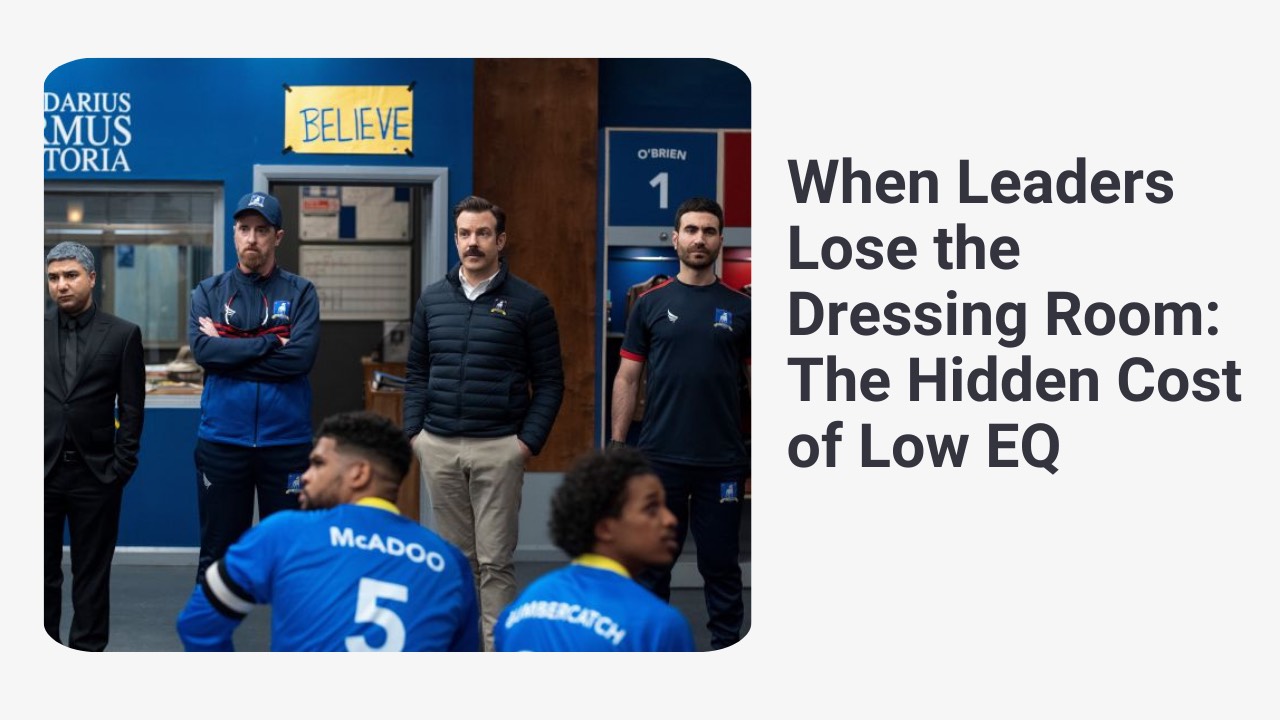
An environment where only the leader speaks while everyone else stands in heavy silence is an enterprise managing its own decline. Actively invite dissenting viewpoints, reward transparency, and listen far more than you speak.
High performance is never a static destination. It is the natural byproduct of a leadership culture that systematically refuses to let any experience pass without extracting its commercial value.
The Elephant in the room
Every leadership team has something it has learned to work around rather than name. Each person's Elephant reacts to the others', and the meeting moves on. Elephant in the Room is a six-hour programme in which a team meets its Elephants and then names the one in the room.
Or start with your own: Meet your Elephant, 10 minutes
Work with EdgeEQ
The Advanced Leadership Programme. For the leader who knows exactly what needs to change, and has watched it not change. One to one with James Rees, 20 hours across six to twelve months. Find out more
Elephant in the Room. For the team where everyone can sense what isn't being said, and no one says it. A six-hour programme for up to 10 leaders, virtual or in person. Find out more
Many organisations start with the team, then take one or two leaders deeper through the Advanced Leadership Programme.
The EdgeEQ letter
One piece a week on the Elephant, the automatic reaction that takes over under pressure, drawn from 20,000+ hours of one-to-one work.
We hate SPAM. We will never sell your information, for any reason.
