
The Corporate Weedkiller Trap: What Dandelions Teach Us About Team Performance
Jun 11, 2026The amateur leader reaches for the weedkiller. The expert audits the soil.
Gardening is rarely the first domain executives look to when trying to solve complex team dysfunction. But if you give me two minutes, I would like to challenge the way you view performance problems.
A few years ago, I developed a sudden, stereotypically middle-aged obsession with cultivating an immaculate lawn. Before long, my attention was completely hijacked by dandelions.
My initial instinct was the amateur one: What is the fastest way to get rid of them?
I spent an immense amount of time, energy, and money pulling them out and spraying them with chemicals. Yet, without fail, they kept returning. The behaviour of the lawn refused to reorganise.
Frustrated by the lack of results, I stopped focusing on the symptom and asked a fundamentally different question: What are dandelions actually a bioindicator of?
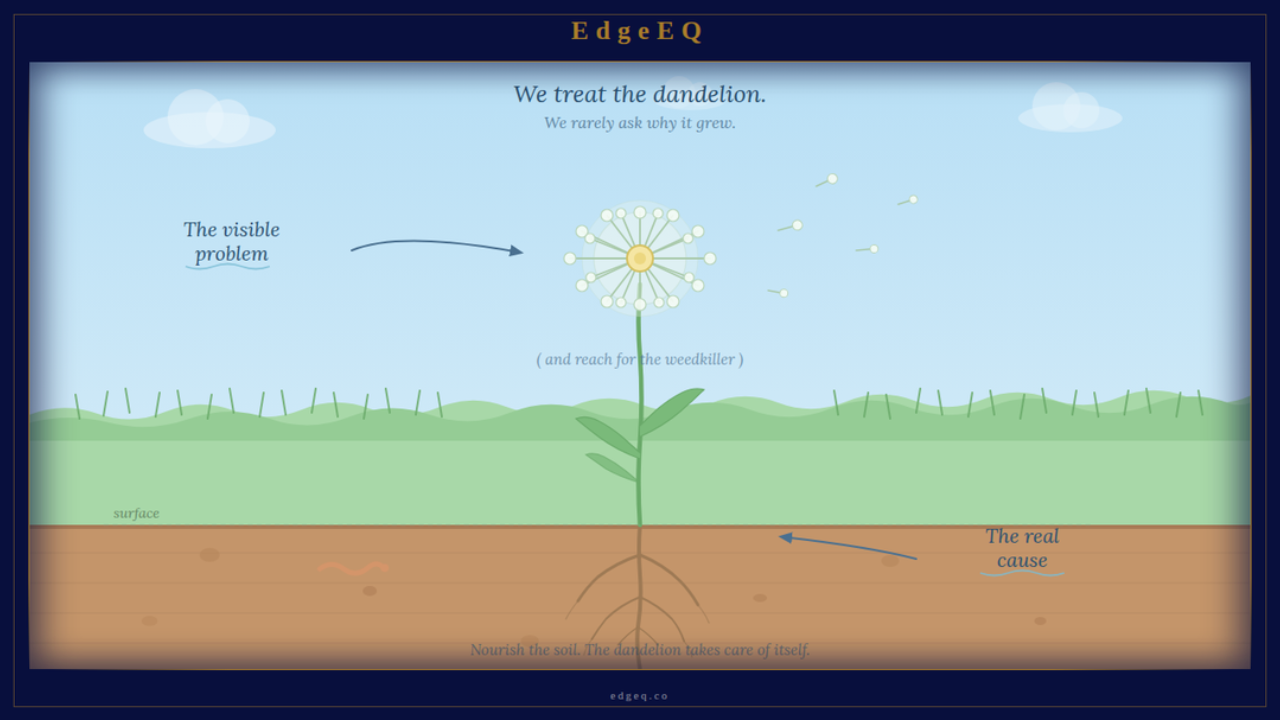
That single shift in perspective opened up a completely new layer of resolution. I discovered that dandelions thrive in specific soil conditions. In my particular case, the root cause was severe soil compaction—the result of heavy machinery driving over the exact same ground for decades.
The weedkiller I had been relying on was entirely useless because it was treating a structural issue as a surface anomaly. Once I addressed the compaction beneath the surface, the weeds disappeared naturally.
The Corporate Weedkiller Trap
In high-stakes corporate environments, leaders are under constant, relentless pressure to deliver with compressed timelines and finite resources. When a "weed" inevitably appears in a team—whether it manifests as missed deadlines, passive-aggressive communication, or a sudden drop in engagement—the instinctive reaction is to reach for the corporate equivalent of weedkiller.
Managers look for something fast. Something that quickly removes the visible problem from the room.
They schedule a hasty feedback session, issue a stern warning, or bring in an external facilitator for a single, energetic team-building afternoon. They want the symptom gone by Monday morning.
This year, I have declined more team development contracts than ever before in my career. I did not turn them down because the organisations were uninteresting, but because the executive sponsors were entirely unwilling to spend the time required to understand the underlying systemic issues. They wanted a quick cosmetic fix for a structural failure.
There is no professional satisfaction in tending to amateur gardens. True execution happens when you operate at the level of the Chelsea Flower Show.
Understanding the Soil
A high-performing team is a destination. It is a space where talented individuals actively want to be, where they slow down, focus, and consistently produce exceptional work.
That level of quality never comes from simply acquiring better management tools, rewriting your corporate values, or pushing harder against bad behaviour. It comes from having the discipline to understand what the organisational soil needed in the first place.
When a team member begins to underperform, the low-resolution response is to blame their motivation or capability. The high-resolution response is to look at the environment:
-
Has the structural clarity of the role been compacted by shifting priorities?
-
Is a culture of politeness suppressing the honest feedback required for growth?
-
Has past leadership reactivity conditioned the team to hide their mistakes?
If you do not change the underlying environment, the old behaviours will always return. The story the system is running will eventually beat whatever temporary fix you apply to the surface.
Is your organisation a place where the best people genuinely want to be, or is it just somewhere they are currently forced to stay?
A Question for You
Think about the most persistent, recurring frustration within your current team or organisation.
If that problem is not actually a defect in the people, but a bioindicator of a deeper issue in your workplace environment—what is the soil telling you?
WORK WITH EDGEEQ
EdgeEQ works at the individual, team and organisational level. Each entry point applies the same methodology—the four stage change architecture—at the scale that is right for where you are.
Whether you are looking for precise executive coaching, a shift in team dynamics, or a full organisational transformation, our approach reaches the level where patterns actually live to create lasting movement.
Stay Ahead of the Curve
Join the EdgeEQ Community.
The world is changing fast, but leadership methodology often lags behind. Join our mailing list to receive sharp insights on neuroscience, trust architecture, and the "how" of behavioural change, delivered directly to your inbox.
Stay connected with the latest news, research, and updates from the edge of leadership evolution.
We hate SPAM. We will never sell your information, for any reason.
